Trickster |
From Wikipedia, the free encyclopediapixture fromthe wikikipedia
The trickster figure Reynard the Fox as depicted in an 1869 children's book by Michel Rodange. In mythology, and in the study of folklore and religion, a trickster is a god, goddess, spirit, man, woman, or anthropomorphic animal who plays tricks or otherwise disobeys normal rules and norms of behavior. It is suggested by Hansen (2001) that the term "Trickster" was probably first used in this context by Daniel G. Brinton in 1885. While the trickster crosses various cultural traditions, there are significant differences between tricksters in the traditions of many Indigenous peoples and those in the Euro-American tradition: "Many native traditions held clowns and tricksters as essential to any contact with the sacred. People could not pray until they had laughed, because laughter opens and frees from rigid preconception. Humans had to have tricksters within the most sacred ceremonies for fear that they forget the sacred comes through upset, reversal, surprise. The trickster in most native traditions is essential to creation, to birth".[1] Native tricksters should not be confused with the Euro-American fictional picaro. One of the most important distinctions is that "we can see in the Native American trickster an openness to life's multiplicity and paradoxes largely missing in the modern Euro-American moral tradition".[2]
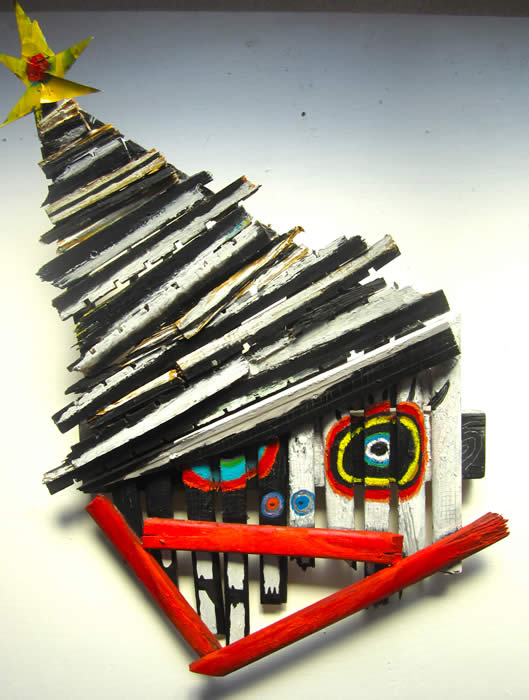
kite circus
if you would like this painting for free clik rite hear
my recent biograffy
these are my words eye was born a black crow on the 13th day of a scorpio moon in the foothills of the arkansas ozark mountains to my scottish irish parents dismay... they took me in nonetheless, fed me, clothed me, sent me to schools and tried to domesticate me... eye attempted to live a normal life... finding employment, trying to marry and even voting regularly but failed mostly and when eye reached full crow adulthood realized eye could no longer deny my coyote nature and immediately began turning over tables and rattling the cages folks immediately said eye was crazy and lots complained eye should stop what eye was doin (those is the folks that let you know you is doing something rite) eye knew this was an important breakthrough and immediately started looking for matches and kerosine and have been settin fires ever since thank you for reading my words
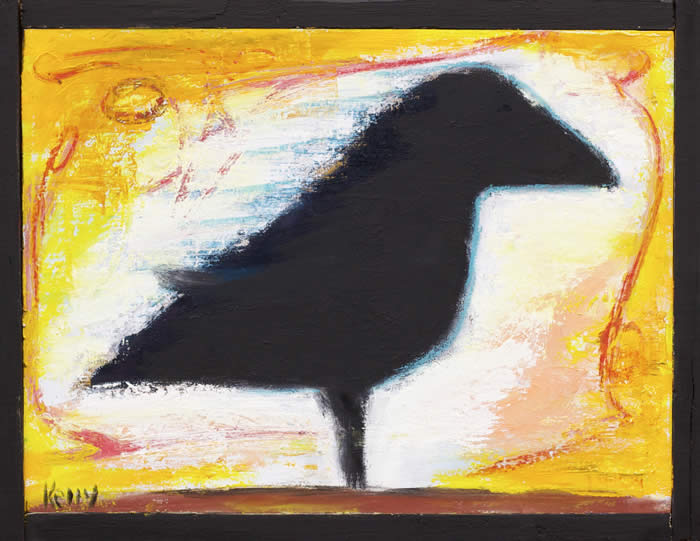
banana peel from 2005
MythologyThe trickster deity breaks the rules of the gods or nature, sometimes maliciously (for example, Loki) but usually, albeit unintentionally, with ultimately positive effects. Often, the rule-breaking takes the form of tricks (eg. Eris) or thievery. Tricksters can be cunning or foolish or both; they are often funny even when considered sacred or performing important cultural tasks. An example of this is the sacred Heyoka, whose role is to play tricks and games and by doing so raises awareness and acts as an equalizer. In many cultures, (as may be seen in Greek, Norse, or Slavic folktales, along with Native American/First Nations lore), the trickster and the culture hero are often combined. To illustrate: Prometheus, in Greek mythology, stole fire from the gods to give to humans. He is more of a culture hero than a trickster. In many Native American and First Nations mythologies, the coyote (Southwestern United States) or raven (Pacific Northwest, coastal British Columbia, Alaska and Russian Far East) stole fire from the gods (stars, moon, and/or sun) and are more tricksters than culture heroes. This is primarily because of other stories involving these spirits: Prometheus was a Titan, whereas the Coyote spirit and Raven spirit are usually seen as jokesters and pranksters. Examples of Tricksters in the world mythologies are given by Hansen (2001), who lists Mercurius in Roman mythology, Hermes in Greek mythology, Eshu in Yoruba mythology and Wakdjunga in Winnebago mythology as examples of the Trickster archetype. Hansen makes the interesting observation that the Trickster is nearly always a male figure. Frequently the Trickster figure exhibits gender and form variability, changing gender roles and engaging in same-sex practices. Such figures appear in Native American and First Nations mythologies, where they are said to have a two-spirit nature. Loki, the Norse trickster, also exhibits gender variability, in one case even becoming pregnant; interestingly, he shares the ability to change genders with Odin, the chief Norse deity who also possesses many characteristics of the Trickster. In the case of Loki's pregnancy, he was forced by the Gods to stop a giant from erecting a wall for them before 7 days passed; he solved the problem by transforming into a mare and drawing the giant's magical horse away from its work. He returned some time later with a child he had given birth to--the eight-legged horse Sleipnir, who served as Odin's steed. In some cultures, there are dualistic myths, featuring two demiurges creating the world, or two culture heroes arranging the world — in a complementary manner. Dualistic cosmologies are present in all inhabited continents[3] and show great diversity: they may feature culture heroes, but also demiurges (exemplifying a dualistic creation myth in the latter case), or other beings; the two heroes may compete or collaborate; they may be conceived as neutral or contrasted as good versus evil; be of the same importance or distinguished as powerful versus weak; be brothers (even twins) or be not relatives at all.[4]
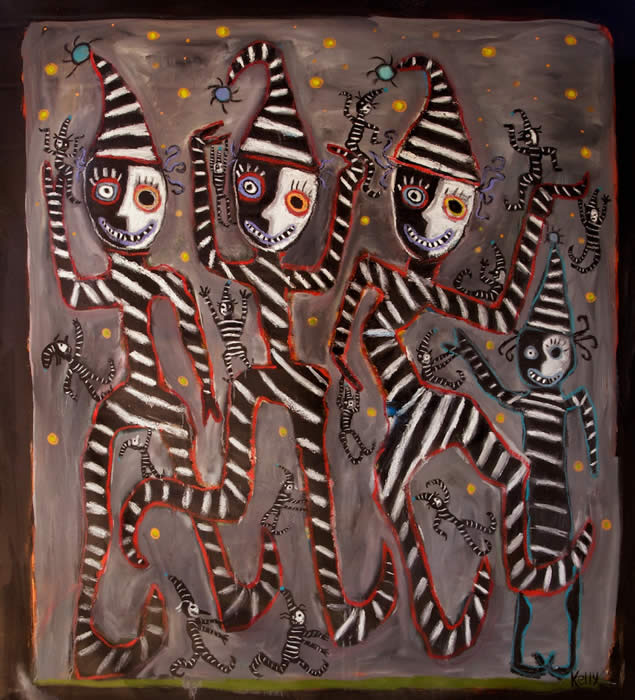
nother paining done 2007 year
CoyoteThe Coyote mythos is one of the most popular among Native American cultures. Coyote is a ubiquitous being and can be categorized in many types. In creation myths, Coyote appears as the Creator himself; but he may at the same time be the messenger, the culture hero, the trickster, the fool. He has also the ability of the transformer: in some stories he is a handsome young man; in others he is an animal; yet others present him as just a power, a sacred one. According to Crow (and other Plains) tradition, Old Man Coyote impersonates the Creator, "Old Man Coyote took up a handful of mud and out of it made people".[5] His creative power is also spread onto words, "Old Man Coyote named buffalo, deer, elk, antelopes, and bear. And all these came into being". In such myths Coyote-Creator is never mentioned as an animal; more, he can meet his animal counterpart, the coyote: they address each other as "elder brother" and "younger brother", and walk and talk together. According to A. Hultkranz, the impersonation of Coyote as Creator is a result of a taboo, a mythic substitute to the religious notion of the Great Spirit whose name was too dangerous and/or sacred to use apart from a special ceremony. In Chelan myths, Coyote belongs to the animal people but he is at the same time "a power just like the Creator, the head of all the creatures". Yet his being 'just like the Creator' does not really mean being 'the Creator': it is not seldom that Coyote-Just-Like-Creator is subject to the Creator, Great Chief Above, who can punish him, send him away, take powers away from him, etc. In the Pacific Northwest tradition, Coyote is mostly mentioned as a messenger, or minor power, "Coyote was sent to the camp of the chief of the Cold Wind tribe to deliver a challenge; Coyote traveled around to tell all the people in both tribes about the contest." As such, Coyote "was cruelly treated, and his work was never done." As the culture hero, Coyote appears in various mythic traditions. His major heroic attributes are transformation, traveling, high deeds, power. He is engaged in changing the ways of rivers, standing of mountains, creating new landscapes and getting sacred things for people. Of mention is the tradition of Coyote fighting against monsters. According to Wasco tradition, Coyote was the hero to fight and kill Thunderbird, the killer of people, but he could do that not because of his personal power, but due to the help of the Spirit Chief; Coyote was trying his best, he was fighting hard, and he had to have fasted ten days before the fight, so advised by Spirit Chief 8. In many Wasco myths, Coyote rivals the Raven (Crow) about the same ordeal: in some stories, Multnomah Falls came to be by Coyote's efforts; in others, it is done by Raven. More often than not Coyote is a trickster, but he is always different. In some stories, he is a noble trickster, "Coyote takes water from the Frog people... because it is not right that one people have all the water." In others, he is mean, "Coyote determined to bring harm to Duck. He took Duck's wife and children, whom he treated badly."
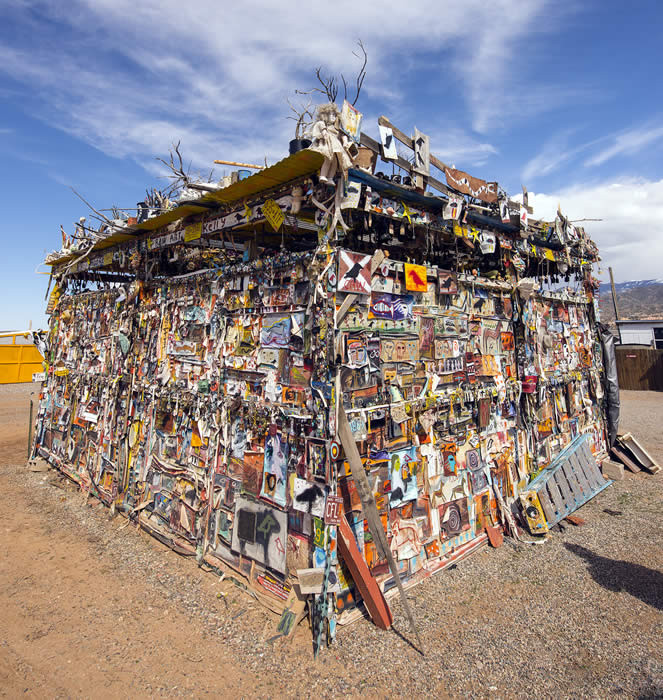
a coyote fillin station (foto curtsy of kitty livingood )
ArchetypeFurther information: List of modern day trickstersThe Trickster is an example of a Jungian archetype. In modern literature the trickster survives as a character archetype, not necessarily supernatural or divine, sometimes no more than a stock character. In later folklore, the trickster is incarnated as a clever, mischievous man or creature, who tries to survive the dangers and challenges of the world using trickery and deceit as a defense. For example many typical fairy tales have the King who wants to find the best groom for his daughter by ordering several trials. No brave and valiant prince or knight manages to win them, until a poor and simple peasant comes. With the help of his wits and cleverness, instead of fighting, he evades or fools monsters and villains and dangers with unorthodox manners. Therefore the most unlikely candidate passes the trials and receives the reward. More modern and obvious examples of that type are Bugs Bunny and The Tramp (Charlie Chaplin) (see list). The trickster is an enduring archetype that crosses many cultures and appears in a wide variety of popular media.
"Lie to a liar, for lies are his coin; Steal from a thief, for that is easy; lay a trap for a trickster and catch him at first attempt, but beware of an honest man." Arab Proverb
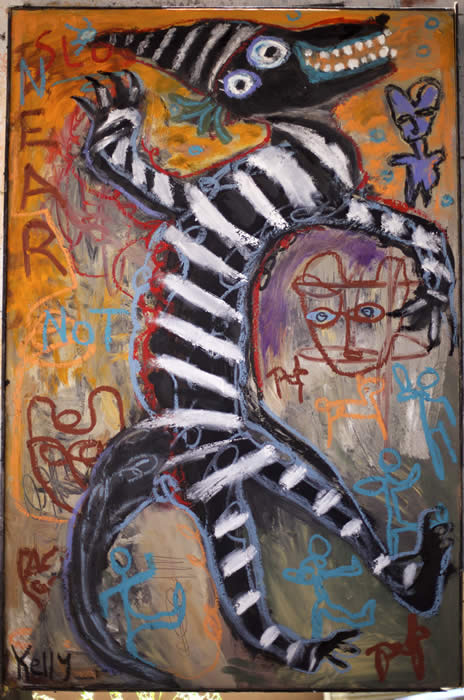
midnight coyote 20008 paining
"The Trickster, Jung says, is an aspect of the shadow archetype, at least in its negative traits The trickster, obviously, deceives, often playfully, sometimes painfully. A very sexual archetype, it has the ability to change genders and play havoc with the hyper-rational personality and community. Examples of the trickster are Satan, Loki, and, in Native American mythology, the coyote, the raven, and the Winnebago trickster. The vampire is, in fact, a kind of trickster, "able to change into many shapes, among them bats, wolves, spiders, butterflies, fog, or even a bit of straw." Clifton Snider
|
|
©KellyMoore
2009 | Web Design: Kelly Moore
|